

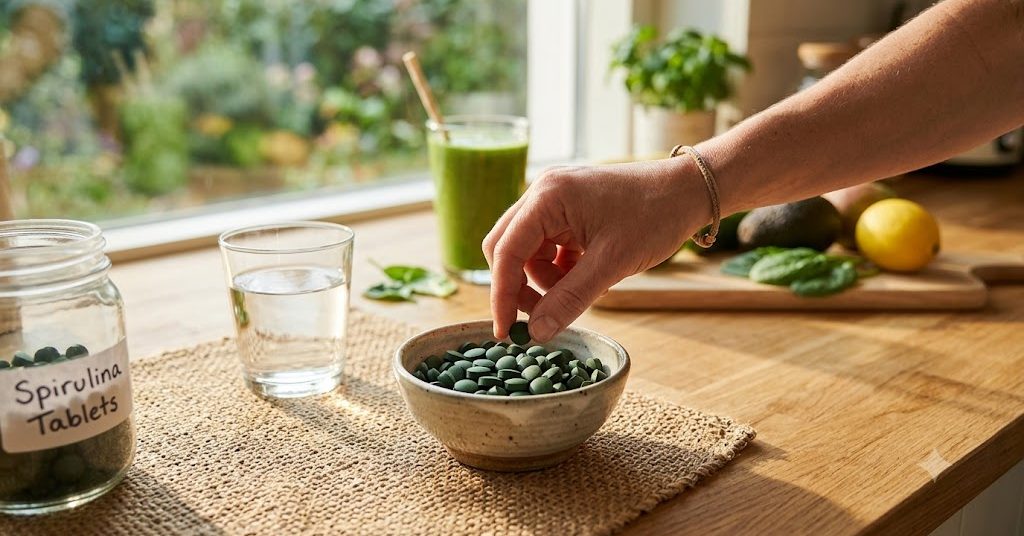
Most people know three things about spirulina: it’s green, it’s healthy, and it’s in a lot of smoothies. All true. All a bit boring.
What’s more interesting is everything underneath that – the stuff that explains why a pond organism ended up being studied by NASA, eaten by the Aztecs, and argued over by nutritionists. Here are nine facts about spirulina that go beyond the label, including one widely repeated claim you should stop believing.
1. It isn’t actually a plant – or even an algae, really
Spirulina is almost always called a “blue-green algae,” but that’s a bit of a fudge. Technically, it’s a cyanobacterium – a bacteria.
That sounds off-putting until you realise cyanobacteria are some of the most important organisms on Earth. They’ve been photosynthesising for billions of years and are a big part of why our atmosphere has oxygen at all. So spirulina sits in a strange middle ground: simple enough to be a bacterium, but able to harness sunlight like a plant. That dual nature is exactly what lets it grow so fast and pack in so much nutrition.
2. The Aztecs were eating it 500 years ago
Spirulina feels like a 21st-century wellness invention. It isn’t – it’s more like a rediscovery.
The Aztecs harvested it from Lake Texcoco, skimmed it off the water, and dried it into cakes called tecuitlatl that they ate as a regular protein source. Spanish chroniclers in the 1500s described it being sold in markets. Halfway across the world, the Kanembu people around Lake Chad in Africa have done much the same for generations, drying it into a food called dihé that’s still eaten today. People worked out spirulina was worth eating centuries before anyone could spell “phycocyanin.”
3. Gram for gram, it’s one of the most nutrient-dense foods we know
This is the fact that earns spirulina the “superfood” label honestly.
It’s around 60–70% protein by dry weight – far higher than most plant foods, and unusually for a plant source, it’s a complete protein with all nine essential amino acids. On top of that it carries iron, B vitamins, beta-carotene, and a spread of antioxidants, all in a tiny serving. Few natural foods deliver this much nutrition per gram, which is the whole reason it keeps showing up in discussions about malnutrition and food security.
4. That blue colour is the interesting part
Spirulina is blue-green, not just green – and the blue matters.
The blue comes from phycocyanin, a pigment that’s also spirulina’s signature antioxidant compound and the focus of much of the research into it. It’s so distinctive that it’s extracted and used as a natural blue food colouring (you’ve probably eaten it in blue sweets or drinks without knowing). When people talk about spirulina’s antioxidant properties, phycocyanin is usually what they mean.
5. It grows ridiculously fast – which is good news for the planet
Spirulina is one of the most efficient food sources on Earth. Under the right conditions it can roughly double its mass in a matter of days, using little more than water, sunlight and basic nutrients.
That efficiency is why it’s taken seriously as a sustainable food. It produces a large amount of protein on a fraction of the land and water that livestock needs, without the same environmental cost. In a world worrying about how to feed itself, a fast-growing protein source that thrives in ponds is genuinely useful.
6. NASA and the ESA have studied it as space food
Here’s the one that surprises people. Both NASA and the European Space Agency have looked at spirulina as a food source for long space missions.
The logic is simple: on a multi-year mission, every gram of cargo is precious, and you’d ideally grow food rather than carry it all. Spirulina ticks both boxes – it’s incredibly nutrient-dense and it can be cultivated in a closed system. The ESA’s MELiSSA project, which designs life-support systems for space, has featured spirulina as a candidate for exactly this. Pond scum, astronaut-approved.
7. The vitamin B12 claim is a myth – don’t fall for it
Time for the myth-bust, because this one genuinely matters for your health.
Spirulina is constantly promoted as a great B12 source for vegetarians and vegans. It isn’t. Most of the B12 in spirulina is “pseudo-B12” – a near-identical lookalike that your body can’t actually use, and which may even interfere with real B12. If you don’t eat animal products, relying on spirulina for B12 could leave you deficient while thinking you’re covered. B12 deficiency is serious, so use a proper supplement or fortified food for that, and enjoy spirulina for everything else it genuinely offers.
A good superfood doesn’t need exaggerated claims – and spotting the overstated ones is how you tell a trustworthy source from a hype machine.
8. Where it’s grown changes everything
Here’s a fact that should affect how you actually buy spirulina: two spirulina products can be worlds apart in quality and safety, depending entirely on where and how they were grown.
Because spirulina absorbs whatever is in its water, spirulina from uncontrolled or polluted sources can carry heavy metals, bacteria, or toxins called microcystins. Spirulina grown in a clean, controlled environment doesn’t have that problem. This is why “spirulina” on a label tells you almost nothing on its own – the cultivation behind it is what counts. Cheap, anonymous spirulina is a genuine gamble; well-sourced spirulina from a reputable manufacturer isn’t.
9. Not all spirulina is absorbed equally well
The final fact is the one the supplement industry has spent the most effort on recently: even good spirulina has an absorption problem.
Its nutrients sit inside relatively large molecules (often above 2,000 Daltons) that your gut can’t fully take in, so some of what you swallow passes through unused. Two people taking spirulina can get different results partly because of this. It’s why newer-generation products focus less on cramming in more nutrients and more on making the existing ones easier for your body to absorb – the difference between what’s in the tablet and what actually gets into you.
The modern footnote
That last point is where spirulina’s story is still being written. Products like Elken’s Cyanor Spiru tackle the absorption problem head-on, using a bio-transformation process to shrink the molecules and a probiotic to support the gut – an attempt to fix the one real weakness in an otherwise remarkable food. If you want the science on that, the difference between Cyanor Spiru and regular spirulina is a topic in its own right.
For now, the takeaway is simpler: spirulina has earned its reputation over centuries and across continents. Just buy it well-sourced, take it consistently, and don’t trust it with your B12.
This article is for general educational purposes and is not medical advice. Always consult a qualified healthcare professional before starting any supplement, especially if you are pregnant, breastfeeding, taking medication or managing a health condition.