

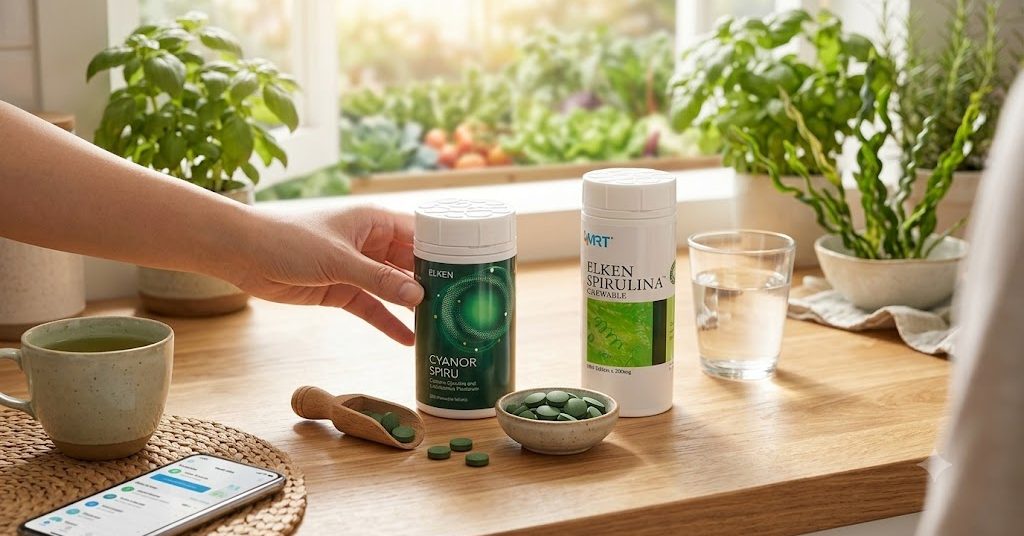
If you’ve taken regular spirulina and felt nothing, you’ve probably wondered whether a pricier “advanced” version is genuinely better or just better marketed.
Fair question. So here’s a straight comparison of Cyanor Spiru against regular spirulina – what actually differs, what doesn’t, and who each one suits. No hand-waving; where there’s a number, you’ll see the number.
First, what they have in common
Let’s be fair to regular spirulina before we separate them, because they share a lot.
Both are spirulina. Both carry the same fundamental package: roughly 60 complete nutrients, high plant protein, B vitamins, iron, antioxidants, and the blue pigment phycocyanin. If you want the full breakdown of what spirulina is and why it’s nutritious in the first place, our guide to what spirulina is covers it. Regular spirulina is a genuinely good superfood – this isn’t a case of one being good and the other being junk.
The difference isn’t what’s in them. It’s how much of it your body can actually use. That single distinction drives everything below.
The core difference: absorption
Here’s the limitation of regular spirulina that most people never hear about.
Regular spirulina has relatively large molecules – typically above 2,000 Daltons (a unit of molecular size). Your gut struggles to absorb large molecules, so a meaningful share of those nutrients passes straight through, unused. The nutrition is in the tablet; it just doesn’t all make it into you.
Cyanor Spiru is put through a bio-transformation process that shrinks the molecules to below 1,000 Daltons – roughly half the size. Smaller molecules cross the gut wall more easily, so more of what you swallow is actually absorbed. In lab testing, 36.28% of Cyanor Spiru’s molecules fell into the smaller, better-absorbed range, versus 18.42% for regular spirulina – about twice as much.
This is the whole ballgame. Every other difference flows from it.
Side by side
Here’s the comparison in full, drawn from Elken’s testing of Cyanor Spiru against regular spirulina:
| Comparison Metric | Regular Spirulina | Cyanor Spiru |
|---|---|---|
| Base ingredient | Spirulina | Spirulina + probiotic (Lactobacillus plantarum) |
| Molecular size | Larger (>2,000 Da) | ~2× smaller (<1,000 Da) |
| Smaller, better-absorbed molecules | 18.42% | 36.28% |
| Protein digestibility | ~60% | ~65% |
| Phycocyanin content | 4.65 g/100g | 15.24 g/100g (3.2× higher) |
| Phenolic content | 7.57 mg GAE/g | 36.87 mg GAE/g (4.8× higher) |
| Antioxidant activity (DPPH) | 1.8 mg AAE/g | 8.38 mg AAE/g (4.7× higher) |
| Built-in probiotic | None | Yes |
Two things stand out beyond absorption.
It carries more active compound to begin with. It’s not just that Cyanor Spiru is better absorbed – it starts with significantly more of the good stuff. Over three times the phycocyanin, nearly five times the phenolics. More to absorb, and a better rate of absorbing it.
It adds a probiotic. Regular spirulina has none. Cyanor Spiru is fortified with Lactobacillus plantarum, which supports the gut – and since the gut is where absorption happens, that compounds the benefit rather than just sitting alongside it.
Does that difference show up in the body?
Lab content is one thing; what happens after you take it is another. This is where the comparison gets more concrete.
In testing that tracked phycocyanin levels in the blood over 24 hours, Cyanor Spiru reached about 10× higher active levels than regular spirulina at the 4-hour mark, and was still 2.5× higher at 12 hours. In plain terms: it’s absorbed faster and stays active longer, rather than the slower, lower uptake seen with regular spirulina. For a daily supplement, that’s the practical difference between “I think it’s doing something” and a measurable response.
So is the upgrade worth it – for everyone?
Here’s the honest answer, because “always buy the premium one” isn’t it.
Regular spirulina is perfectly fine if you simply want a basic, budget-friendly nutritional top-up, you don’t have absorption concerns, and you’re not fussed about feeling a noticeable difference. It’s a good food. For some people, that’s enough.
Cyanor Spiru makes more sense if you’ve tried regular spirulina and felt little, you’re older or have compromised gut health (where absorption is already a struggle), or you simply want more of what you’re paying for to actually reach your system. Better absorption matters most precisely for the people whose bodies absorb least efficiently – which, in a stressed, over-processed modern diet, is a lot of us.
The deciding question isn’t “which has more nutrients on the label.” It’s “which gets more nutrients into me.” On that measure, the data favours Cyanor Spiru clearly – but whether that’s worth the difference in price is a judgement only you can make.
The bottom line
Regular spirulina and Cyanor Spiru aren’t really competitors so much as two generations of the same idea. One is the original superfood; the other is that superfood with its single biggest weakness – absorption – engineered out, plus a probiotic for good measure.
If budget is the priority and you just want the nutritional basics, regular spirulina does the job. If you want more of what you take to actually count, Cyanor Spiru is built for exactly that.
Either way, the same two rules apply to any spirulina: buy it well-sourced, and take it consistently. Also, read the 7 benefits of Cyanor Spiru for the deeper version of what’s above.
Cyanor Spiru is a nutritional supplement intended to support daily wellness as part of a balanced diet and healthy lifestyle. It is not intended to diagnose, treat, cure or prevent any disease. Individual results may vary. MAL25036184N · KKLIU 1769 / EXP 31.12.2028.