

You’ve decided to give spirulina a go. Good – but a quick search throws up confusing advice on how to actually take it: how much, when, with food or without, powder or tablet. Get it slightly wrong and you might deal with mild side effects or simply not get the most out of it.
So here’s the straightforward, practical guide. No fluff – just how to take spirulina properly, so it works for you and goes down easily.
How much spirulina should you take?
Let’s start with the question everyone has. The honest answer: it depends on the product and why you’re taking it – so the golden rule is always to follow the directions on your specific product’s label. Different products are formulated and dosed differently, and the label is written for that exact formulation.
As a general guide, typical daily amounts of spirulina fall somewhere between 1 and 5 grams, depending on the product and purpose. Many people start at the lower end and adjust. More isn’t automatically better – beyond a sensible daily amount, you’re not gaining much, and you raise the chance of mild digestive effects.
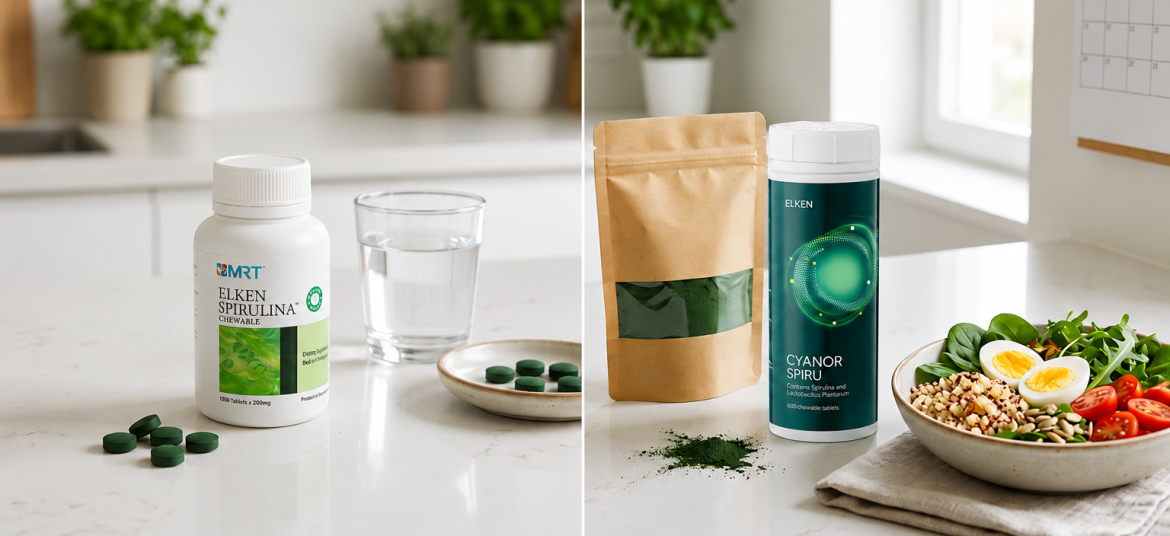
To give a concrete example: Elken’s Cyanor Spiru comes in 200mg tablets, with a recommended adult intake of 10 tablets twice a day – 20 tablets daily – taken after meals. That works out to around 4 grams a day, comfortably within the typical range. For children, the recommended amount is lower; check the product label and consult a doctor or paediatrician before giving spirulina to a child.
When is the best time to take spirulina?
There’s no single “magic” time – consistency matters more than timing. That said, a few practical pointers help.
Take it with or after meals. This is the most useful timing tip. Taking spirulina with food helps reduce the mild digestive upset some people get on an empty stomach, and food can aid absorption. If your product recommends splitting the dose (as Cyanor Spiru does, morning and evening), taking each portion with a meal works neatly.
Spread it across the day if the dose is large. If you’re taking a higher number of tablets, splitting them between two meals is gentler on your stomach than taking them all at once.
Mind the evening, if you’re sensitive. A few people find spirulina mildly energising. If you’re one of them and you notice it affecting your sleep, take your later dose earlier in the evening rather than right before bed. Most people aren’t affected, so this is a “see how you go” point rather than a rule.
Pre-workout is an option for active people. If you exercise, some people like taking spirulina beforehand as part of their nutritional prep. Not essential – just an option.
The single most important “when,” though, is simply: consistently, every day. A supplement only works if you actually take it, which is really a habit question – our guide to daily wellness habits covers how to make a daily routine stick.
With or without food?
Short version: with food, in most cases. Taking spirulina alongside a meal is the easiest way to avoid the mild nausea or bloating that an empty stomach can bring, especially when you’re starting out. Once your body is used to it, some people take it on an empty stomach without issue – but “with food” is the safe default, and many products (Cyanor Spiru included) recommend taking it after meals for this reason.
Powder, tablets or capsules – and how to take each
Spirulina comes in a few forms, and how you take it depends on which you’ve got:
- Tablets are the most convenient: just swallow with water, no taste to deal with. The simplest option for daily use, and ideal if you don’t love spirulina’s strong flavour.
- Capsules work the same way – swallow with water – and suit people who find tablets harder to take.
- Powder is the most flexible but the most acquired taste. It has a strong, earthy, “green” flavour that’s noticeable. The trick is to mask it: blend it into a fruit smoothie or juice rather than mixing it into plain water. A word of warning – it stains, so mind your worktop and your clothes.
If you’re new to spirulina and unsure, tablets are the easiest place to start. (For more on choosing a quality product in the first place, see our guide on how to choose a good spirulina.)
How to start: ease into it
Here’s the tip that prevents most of the mild side effects people complain about: don’t go straight to the full dose on day one.
Your gut needs a little time to adjust. Start with a smaller amount than the full recommended dose for the first several days, then build up gradually to the full amount over a week or two. This dramatically reduces the chance of the bloating, gas or mild nausea that can come from jumping in at full speed. If you do get mild effects, ease back to a smaller dose and build up more slowly. (For the full picture on what’s normal and what’s not, see our guide to spirulina side effects.)
Tips to get the most out of it
A few final practical pointers to round it off:
- Drink plenty of water through the day – it helps absorption and heads off the mild headache some people get.
- Be consistent. The benefits of spirulina come from steady daily intake, not the occasional dose. Build it into an existing routine – with breakfast, with dinner – so you don’t forget.
- Give it time. This isn’t a caffeine hit; it’s a nutritional top-up. Think in terms of weeks of consistent use, not instant results.
- Quality first. None of this matters if the product itself is poor. A clean, well-sourced spirulina taken imperfectly beats a dubious one taken perfectly.
The bottom line
Taking spirulina well isn’t complicated: follow your product’s dosage, take it with food, start low and build up, drink water, and be consistent. That’s genuinely most of it.
If you’re using a product like Cyanor Spiru, the routine is already mapped out for you – 10 tablets twice a day, after meals – which takes the guesswork out of it. Build that into your morning and evening, give it a few weeks, and let consistency do the work. If you’d like to understand what you’re actually taking first, start with our guide to what spirulina is, or see the benefits of Cyanor Spiru for what to expect from it.
This article is for general educational purposes and is not medical advice. Always follow the directions on your product’s label and consult a qualified healthcare professional before starting any supplement, especially if you are pregnant, breastfeeding, taking medication, managing a health condition, or considering a supplement for a child. Cyanor Spiru is a nutritional supplement intended to support daily wellness as part of a balanced diet; it is not intended to diagnose, treat, cure or prevent any disease. MAL25036184N · KKLIU 1769 / EXP 31.12.2028.