

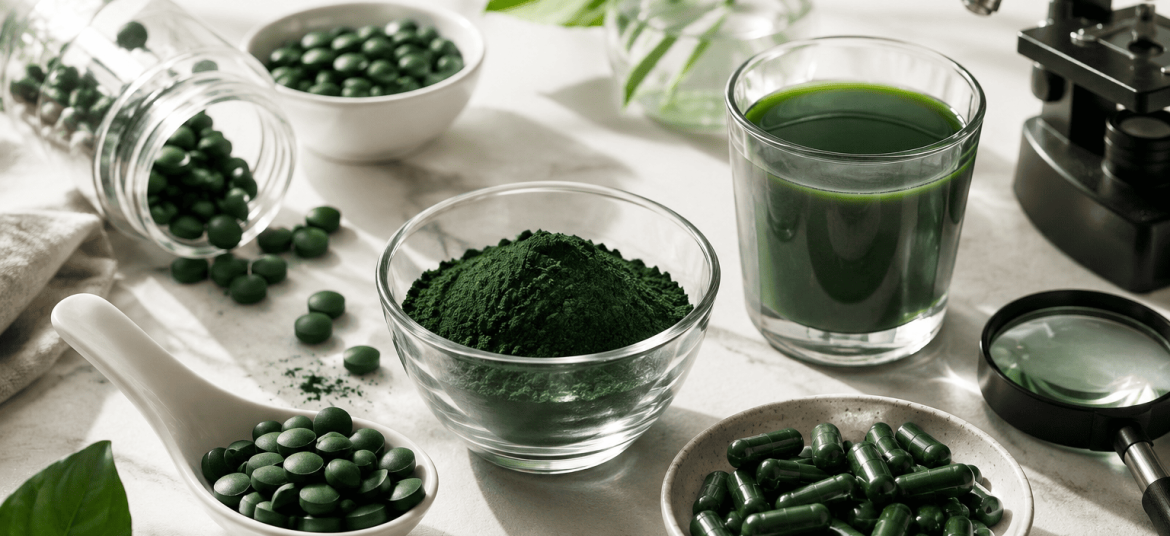
Walk into any pharmacy or scroll any marketplace and you’ll find a dozen spirulina products at wildly different prices, all making similar promises. So a fair question: are they actually different, or are you just paying for nicer packaging?
They’re genuinely different – and the gap between a good spirulina and a poor one is bigger than most people realise. It’s the difference between a clean, well-absorbed superfood and, at worst, something that does more harm than good. Here’s what actually separates them, and how to choose a good spirulina.
Why “it’s all the same spirulina” is wrong
It’s tempting to assume spirulina is a commodity – that the green powder in a cheap tub is the same as the green powder in a premium one. It isn’t, for one fundamental reason.
Spirulina is a living organism, and it absorbs whatever is in the water it grows in. That single fact drives everything. Two spirulina products can differ enormously in purity, safety and how much benefit you actually get – depending entirely on how they were grown and processed. The label says “spirulina” on both; what’s behind the label is where the real variation lives.
So choosing well comes down to four things: where it’s grown, how it’s processed, how well your body can absorb it, and whether the manufacturer can prove any of it.
1. Source and purity: the safety issue most people miss
This is the one that actually matters for your health, so it goes first.
Because spirulina absorbs its surroundings, spirulina grown in uncontrolled, polluted or wild water can accumulate genuinely harmful contaminants – heavy metals like lead and mercury, harmful bacteria, and toxins called microcystins produced by other algae that grow alongside it. This isn’t scaremongering; it’s the single biggest reason quality control matters for spirulina specifically. Poorly sourced spirulina can be contaminated to the point of being unsafe.
Good spirulina avoids this by being cultivated in a clean, controlled environment rather than harvested from open wild sources – so growing conditions, water quality and purity are monitored rather than left to chance.
What to look for: spirulina grown in controlled conditions, from a manufacturer transparent about where and how it’s produced. If a product won’t tell you where its spirulina comes from, treat that as the answer.
2. Processing: where good nutrition gets destroyed (or preserved)
Once spirulina is harvested, how it’s processed decides whether its nutrients survive the journey to your tablet.
Spirulina’s most valuable compounds – antioxidants, vitamins, and its signature blue pigment phycocyanin – are delicate. Phycocyanin in particular is what much of spirulina’s antioxidant reputation rests on; it’s a peer-reviewed antioxidant shown to neutralise several types of damaging free radicals. But it’s heat-sensitive. Process spirulina carelessly with high heat and you can degrade the very compounds you’re paying for, leaving a product that’s nutritionally a shadow of what it should be.
This is why low-temperature processing matters – it preserves the heat-sensitive nutrients rather than cooking them off. Cheaper, high-heat drying is faster and cheaper for the manufacturer, but it costs you the nutrition.
What to look for: evidence of gentle, low-temperature processing designed to preserve nutrients, rather than the cheapest possible drying.
3. Absorption: the difference between “contains” and “delivers”
Here’s the factor almost no one checks, and arguably the most important: it’s not what’s in the spirulina that benefits you, it’s what your body can actually absorb.
Spirulina is genuinely nutrient-dense. Peer-reviewed reviews put it at 55–70% high-quality protein by dry weight, with a complete amino acid profile and a broad spread of vitamins, minerals and antioxidants – which is exactly why it’s earned its “superfood” reputation. But nutrient content on a label only helps you if your body can take it in. This is bioavailability, and it’s where spirulina has a genuine, well-documented limitation.
Spirulina’s nutrients are held inside relatively large molecules and tough cell walls that your gut can’t fully break down, so a portion passes through unused. The principle is simple and not controversial: smaller, more accessible molecules are easier for the body to absorb. It’s why newer-generation spirulina products focus specifically on improving absorption rather than just packing in more nutrients – because more nutrients you can’t absorb is just more waste.
What to look for: whether the product does anything to address absorption, or simply relies on raw nutrient content and hopes for the best.
4. Proof: certifications and transparency
Finally, the meta-point: can the manufacturer actually back up any of the above? Anyone can claim clean cultivation and careful processing. Quality manufacturers can prove it.
What to look for:
- Recognised quality and safety certifications – GMP (Good Manufacturing Practice), HACCP (food safety), ISO standards, and for the Malaysian market, halal certification. These signal audited, controlled manufacturing rather than unverified claims.
- A registered product (in Malaysia, a product registered with the relevant authorities) from an established brand, rather than an anonymous bulk import.
- Transparency about sourcing, processing and testing. Reputable manufacturers publish this; you can often find it on a brand’s science and technology or quality pages.
A certification stack isn’t marketing fluff – for something you put in your body daily, it’s the difference between a claim and a guarantee.
Why price is a terrible shortcut
People naturally reach for price as a proxy for quality – assume expensive means good, cheap means bad. It’s an unreliable shortcut in both directions.
A high price can reflect better cultivation, gentle processing and proper testing – or it can just reflect marketing and packaging. A low price might be a genuine bargain – or it might mean corners were cut on exactly the things that matter: sourcing, purity, processing. Price tells you what something costs, not what’s behind it.
The four factors above tell you what’s behind it. Use those, not the price tag.
A note on the gut
One more thing worth knowing, because it connects to absorption. Some spirulina products now add a probiotic – most commonly Lactobacillus plantarum, one of the best-studied probiotic strains, supported by a 2024 systematic review and meta-analysis of its benefits for digestive health. The logic is sound: your gut is where absorption happens, so supporting gut health can help your body make better use of nutrients overall. It’s not essential, but it’s a genuine plus where you find it.
The bottom line
Choosing a good spirulina isn’t about finding the cheapest tub or the one with the loudest claims. It comes down to four things you can actually check: clean source, careful processing, real absorption, and provable quality.
Get those right and spirulina is one of the most sensible additions you can make to your diet. Get them wrong – particularly source and purity – and you’re gambling with something you swallow every day.
If you’d rather not audit all four yourself, the shortcut is to choose an established, certified brand that’s transparent about all of them. Elken’s Cyanor Spiru, for example, is built around exactly these factors – clean cultivation, low-temperature processing, a bio-transformation step that improves absorption, and a full certification stack – which is one way to tick the boxes without doing the homework yourself.
This article is for general educational purposes and is not medical advice. Always consult a qualified healthcare professional before starting any supplement, especially if you are pregnant, breastfeeding, taking medication or managing a health condition. Cyanor Spiru is a nutritional supplement intended to support daily wellness as part of a balanced diet; it is not intended to diagnose, treat, cure or prevent any disease.