

Spirulina gets called a “superfood” so often that the word has almost stopped meaning anything. So let’s skip the hype and answer the real questions: what actually is it, what’s genuinely in it, and is it worth taking?
Here’s the honest version – the good, the overstated, and the bits most articles conveniently leave out.
What is spirulina, exactly?
Spirulina is a blue-green algae – though technically, it’s not an algae at all. It’s a cyanobacterium: a microscopic, single-celled organism that’s been photosynthesising on Earth for billions of years, long before plants existed.
It grows naturally in warm, alkaline freshwater lakes, where it forms a deep blue-green bloom on the surface. Under a microscope, it appears as tiny tightly-coiled spirals – which is exactly where the name comes from. The two species used in supplements are Arthrospira platensis and Arthrospira maxima, though you’ll usually see them sold under the older, more familiar name “spirulina.”
That blue-green colour isn’t just for show. It comes from two pigments: chlorophyll (the green) and phycocyanin (the blue) – and phycocyanin, as we’ll see, is one of the main reasons spirulina is interesting at all.
A short history: humanity’s oldest superfood
Spirulina isn’t a modern invention. People have been eating it for centuries.
The Aztecs harvested it from Lake Texcoco, dried it into cakes they called tecuitlatl, and ate it as a regular food. On the other side of the world, the Kanembu people around Lake Chad in Africa have done much the same for generations – drying it into a sun-baked food known as dihe, still eaten today.
It’s also been to space. Both NASA and the European Space Agency have studied spirulina as a potential food source for long missions, precisely because it delivers an enormous amount of nutrition in a tiny amount of mass – useful when every gram of cargo counts.
So before any of the wellness marketing existed, spirulina had already earned its reputation the hard way: by keeping people nourished.
What’s actually in spirulina?
This is where spirulina genuinely impresses. Gram for gram, it’s one of the most nutrient-dense foods on the planet.
A typical serving of dried spirulina contains:
- Protein – around 60–70% of its dry weight, which is exceptionally high. Crucially, it’s a complete protein, meaning it contains all nine essential amino acids your body can’t make itself.
- Phycocyanin – the blue pigment, and spirulina’s signature antioxidant compound.
- Iron, magnesium, potassium and other minerals in meaningful amounts.
- B vitamins, beta-carotene (provitamin A) and vitamin K.
- GLA (gamma-linolenic acid) – a beneficial omega-6 fatty acid that’s rare in most diets.
- Chlorophyll and other natural pigments.
All of this in a food that’s almost entirely plant-based and naturally low in calories.
One honest caveat worth knowing. Spirulina is often promoted as a vitamin B12 source for vegetarians and vegans. Be careful here. Most of the B12 in spirulina is “pseudo-B12” – a form your body can’t reliably use. If you don’t eat animal products, don’t rely on spirulina alone for B12; you still need a proper supplement or fortified food. Any article that tells you otherwise is overselling.
What are the potential benefits of spirulina?
Here’s where we need to separate what’s established from what’s promising but unproven.
What’s solid: spirulina is a concentrated source of plant protein, antioxidants and micronutrients. As a daily nutritional top-up, it can help fill the gaps in a diet that’s heavy on processed, refined food and light on whole nutrients – which describes a lot of modern eating. Its antioxidant compounds, particularly phycocyanin, help support the body’s natural defences against oxidative stress, the cellular wear-and-tear driven by pollution, stress and poor diet.
What’s promising but still being researched: spirulina is an active area of scientific study, and researchers continue to explore its role in various aspects of general health and wellbeing. Much of this research is still early – often small studies – so it’s best treated as encouraging rather than conclusive.
The sensible way to think about it: spirulina is a genuinely good nutritional support, not a medicine. It supports a healthy diet; it doesn’t replace one, and it isn’t a treatment for any condition. If you’re hoping it’ll fix a specific health problem, talk to a doctor rather than a supplement label.
Is spirulina safe? Side effects and who should be careful
For most healthy adults, good-quality spirulina is considered safe to take daily. Mild side effects, when they happen, are usually digestive – a bit of bloating or a change in bowel habits as your body adjusts – and tend to settle.
That said, spirulina isn’t for everyone. You should be cautious, and check with a healthcare professional first, if you:
- Have phenylketonuria (PKU) – spirulina contains phenylalanine, which people with PKU must strictly limit.
- Have an autoimmune condition – spirulina may stimulate immune activity, which isn’t always desirable.
- Take blood-thinning or immunosuppressant medication – there’s potential for interaction.
- Are pregnant or breastfeeding – not because it’s known to be harmful, but because quality and safety data are limited, so caution is sensible.
The bigger safety issue, though, isn’t spirulina itself. It’s where the spirulina comes from – which brings us to the most important practical point in this whole guide.
How to choose a good spirulina (this matters more than you’d think)
Not all spirulina is equally safe, and this is the part casual buyers miss.
Spirulina absorbs what’s around it. Grown in uncontrolled, polluted or wild water, it can become contaminated with heavy metals, harmful bacteria, or toxins called microcystins (produced by other algae that grow alongside it). Poorly produced spirulina can do more harm than good.
This is why cultivation and processing matter as much as the spirulina itself. When choosing a product, look for:
- Spirulina grown in a clean, controlled environment rather than harvested from open wild sources.
- Recognised quality and safety certifications – for example GMP, HACCP and halal certification, which signal controlled, audited manufacturing. (Reputable manufacturers are usually transparent about this; you can often see a brand’s standards on pages like Elken’s science and technology overview.)
- A clear, registered product from an established brand, rather than an anonymous bulk powder.
A cheap spirulina of unknown origin is a false economy. With something you’re putting into your body every day, source is everything.
How do you take spirulina?
Spirulina comes in three main forms, and the “best” one is simply the one you’ll take consistently:
- Tablets – convenient, no taste to deal with, easy to dose. The most popular choice for daily use.
- Powder – flexible and cost-effective; you can blend it into smoothies or juice. Be warned: it has a strong, earthy, distinctly “green” taste that not everyone enjoys, and it stains.
- Capsules – like tablets, but easier to swallow for some.
How much you take depends on the product, so follow the directions on the label and build up gradually rather than starting at a high dose. If you’re on medication or managing a health condition, make sure to run it past your doctor first.
The modern evolution of spirulina
For all its strengths, traditional spirulina has one long-standing limitation: absorption. Its nutrients sit inside relatively large molecules that your gut can’t fully take in, so a portion of what you swallow passes through unused. Brilliant nutrition on paper; only partly delivered in practice.
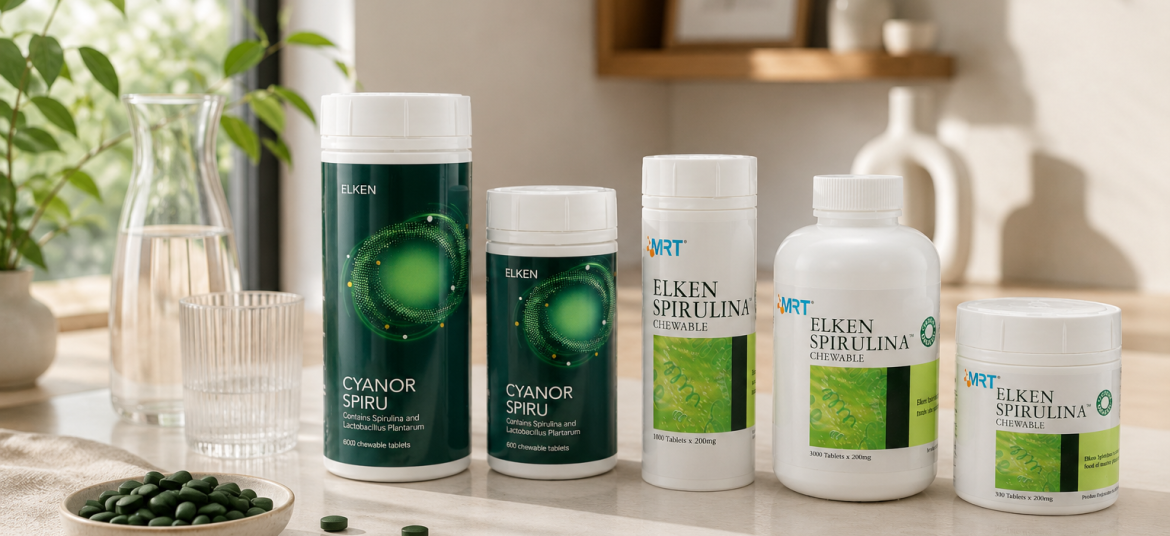
This is the problem newer-generation spirulina products have set out to solve. Elken’s Cyanor Spiru, for instance, uses a bio-transformation process to break the spirulina down into much smaller, more readily absorbed molecules, and adds a probiotic to support the gut – the idea being that more of the goodness actually reaches your system. It’s spirulina taken back to the lab and re-engineered for how people eat and live today.
That’s a topic in its own right, and if you’re curious about how it came about, the story behind Cyanor Spiru covers the 50-year research lineage behind it.
The bottom line on spirulina
Spirulina has earned its superfood reputation honestly. It’s one of the most nutrient-dense foods we know of – rich in complete protein, antioxidants and micronutrients, with centuries of use behind it.
It isn’t magic, and it isn’t medicine. It won’t undo a poor diet, and a few of its popular claims (looking at you, B12) are overstated. But as a daily nutritional top-up – particularly for the gaps modern eating leaves behind – good-quality spirulina is one of the more sensible additions you can make to your routine.
The two things that decide whether it’s worth it: buy a clean, well-sourced product, and take it consistently. Everything else is detail.
This article is for general educational purposes and is not medical advice. Always consult a qualified healthcare professional before starting any supplement, especially if you are pregnant, breastfeeding, taking medication or managing a health condition. Cyanor Spiru is a nutritional supplement intended to support daily wellness as part of a balanced diet; it is not intended to diagnose, treat, cure or prevent any disease.