

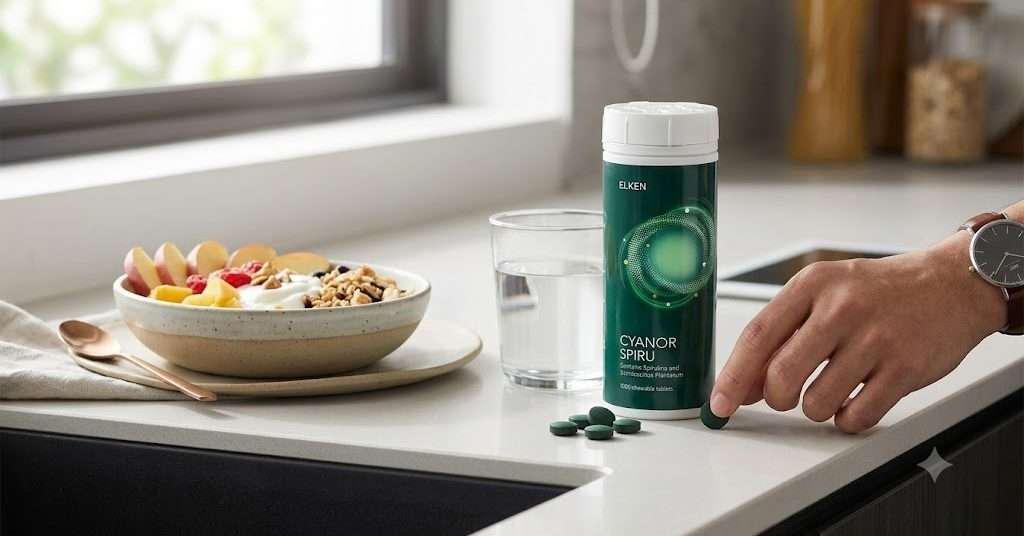
You eat three meals a day. You’re not starving. So why do you still feel tired by 3pm, slow to recover and a bit “off” even when nothing’s wrong?
If that sounds familiar, you’re not imagining it – and you’re not alone. There’s a name for it: silent hunger. It’s when your body gets enough food but not enough nutrients. And it’s become a quietly common problem in Malaysia, where convenience has slowly crowded out nourishment.
This is the gap Cyanor Spiru was built to address. But to understand why it exists at all, you need to start with a much older story – one that spans two generations, three countries and more than 50 years of stubborn research into a single blue-green algae.
First, what is silent hunger – and why does it affect so many of us?
Modern Malaysian life looks comfortable on the surface. Food is everywhere, often within tapping distance on a delivery app. But look closer and the picture changes.
We eat more processed and refined food than our parents did. Skip meals, then overcompensate at night. Sit for hours, sleep too little and run on stress. The result is a strange contradiction: high calories, low nutrition. Your plate is full, but your cells are running short.
It shows up in the data, too. According to the National Health and Morbidity Survey 2023, 54.4% of Malaysian adults were overweight or obese – up from 44.5% in 2011. We’re eating more than ever, yet our health markers are heading the wrong way. That’s silent hunger at a national scale.
This is exactly why interest in nutrient-dense superfoods has climbed – and why spirulina, one of the most concentrated natural foods on the planet, keeps coming up in the conversation.
A superfood with surprisingly ancient roots
Spirulina isn’t a modern wellness fad dressed up in a green label. People have been eating it for centuries.
The Aztecs harvested it from Lake Texcoco and dried it into cakes. Communities around Lake Chad in Africa have done something similar for generations, drying it into a food they call dihe. Long before anyone could measure phycocyanin or protein content in a lab, people already knew this green algae kept them strong.
What modern science later confirmed is why. Gram for gram, spirulina is extraordinarily nutrient-dense – packed with plant protein, vitamins, minerals, antioxidants and natural pigments like phycocyanin (the compound behind its deep blue-green colour). NASA has even studied it as a food source for long space missions, precisely because it delivers so much nutrition in so little mass.
So spirulina is genuinely impressive. Which raises an awkward question.
If spirulina is so good, why don’t people always feel the difference?
This is the part most brands skip. But it’s the whole reason Cyanor Spiru exists, so it’s worth being honest about.
Plenty of people take regular spirulina and feel… not much. The issue usually isn’t the spirulina itself. It’s a less glamorous word: bioavailability – how much of what you swallow your body can actually absorb and use.
Here’s the catch. Regular spirulina tends to have relatively large molecules, often above 2,000 Daltons (a Dalton is just a unit for measuring molecular size). Larger molecules are harder for your gut to absorb. So a portion of those impressive nutrients can pass straight through without ever making it into your bloodstream.
Now stack on the modern reality. Many of us have compromised gut health from years of processed food and stress, which makes absorption even less efficient. So you end up in the worst-case scenario: a body that needs more nutritional support but is less able to use what it gets.
In other words, having good nutrition on the label isn’t the same as getting good nutrition into your cells. And that’s a problem a normal spirulina tablet can’t solve on its own.
Enter the Kodo family: 50 years on one humble algae
This is where the story gets human.
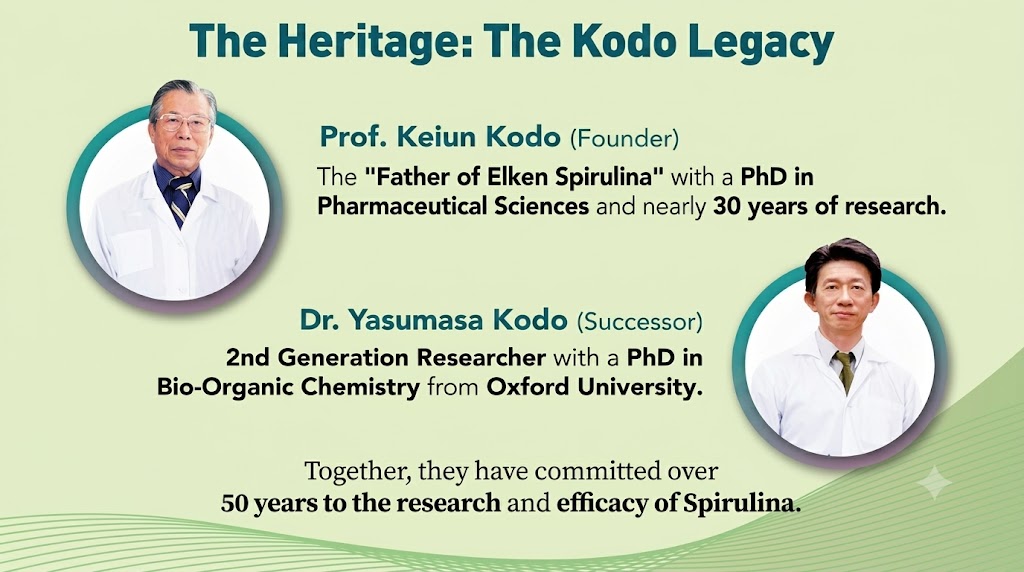
Elken’s spirulina heritage traces back to Professor Keiun Kodo, widely regarded as the “Father of Elken Spirulina.” With a PhD in Pharmaceutical Sciences and close to 30 years dedicated to spirulina research, he spent his career trying to understand what this algae could really do for the body.
His work didn’t end with him. His successor, Dr Yasumasa Kodo, took it further – earning a PhD in Bio-Organic Chemistry from Oxford University and continuing the research as a second-generation scientist. Between them, the Kodo family has committed more than 50 years to studying spirulina’s quality and effectiveness.
That lineage matters for one simple reason: Cyanor Spiru isn’t a product that appeared overnight to ride a trend. It’s the latest chapter of a decades-long obsession with making spirulina work better. (You can see how this fits into Elken’s broader track record on its achievements and milestones page.)
The breakthrough: making spirulina smaller so your body can use more of it
If the problem with regular spirulina is molecule size, the obvious goal is to shrink it. Easy to say. Hard to do without destroying the nutrients in the process.
That’s the engineering challenge Cyanor Spiru’s proprietary bio-transformation technology was built to solve – and Elken developed it with scientific guidance from lead scientist Dr Meng, whose background spans microbial fermentation, food engineering and functional-ingredient R&D, with dozens of patents to his name. (It’s the kind of work that runs through Elken’s wider science and technology capabilities, from its GMP-certified manufacturing plant to its accredited research laboratory.)
In plain terms, here’s what the process does:
It starts with premium spirulina powder, blended with a probiotic strain (Lactobacillus plantarum). This goes through a controlled bio-transformation process in a fully automated tank, designed to break the spirulina down into smaller, more readily absorbable molecules – below 1,000 Daltons. Crucially, it uses low-temperature, low-pressure handling to preserve the delicate nutrients rather than cook them off.
The result is a spirulina that’s roughly 2× smaller in molecular size than regular spirulina – which makes a real, measurable difference to how much your body can take in.
What “smaller molecules” actually means for you
This is where Cyanor Spiru moves from a nice story to something you can point to. The smaller molecular size translates into measurably better absorption and richer active content compared with regular spirulina:
| What Was Measured | Regular Spirulina | Cyanor Spiru | Difference |
|---|---|---|---|
| Smaller molecules (better absorbed) | 18.42% | 36.28% | ~2× more |
| Phycocyanin content | 4.65 g/100g | 15.24 g/100g | 3.2× higher |
| Phenolic content | 7.57 mg GAE/g | 36.87 mg GAE/g | 4.8× higher |
| Antioxidant activity (DPPH) | 1.8 mg AAE/g | 8.38 mg AAE/g | 4.7× higher |
The takeaway in one line: a higher share of Cyanor Spiru’s nutrients is in a form your body can actually absorb – and it carries significantly more of the active compounds spirulina is valued for. Less waste, more value from every tablet.
It’s also fortified with a probiotic (Lactobacillus plantarum), supporting the gut – which is, after all, where absorption happens in the first place. A neat bit of logic: improve the gut, and you improve the body’s ability to use everything else.
Built differently, on purpose
There’s a quality angle here that’s easy to overlook. Not all spirulina is equally safe. Spirulina harvested from uncontrolled wild sources can carry contaminants like heavy metals and bacteria. Cyanor Spiru is formulated with spirulina cultivated in a clean, controlled environment – which is the difference between a superfood and a liability.
Add the Kodo family’s research lineage, the Dr Meng-led engineering, and Elken’s position as the 1st and pioneer of this bio-transformation approach in Malaysia, and you get the real point of the product: this isn’t regular spirulina with a new label. It’s a genuine attempt to fix spirulina’s oldest limitation.
Where this leaves you
The story behind Cyanor Spiru is, at its heart, a story about a gap – the gap between what you eat and what your body actually receives.
Regular spirulina is a brilliant superfood held back by one stubborn problem: absorption. Fifty years of research, two generations of scientists and a modern bio-transformation process later, Cyanor Spiru is Elken’s answer to that problem – spirulina re-engineered for the way Malaysians actually live now: busy, stressed, over-fed and under-nourished.
It won’t undo a poor diet or replace good sleep and movement; nothing in a tablet can. But as a daily nutritional top-up for modern life, it’s spirulina that’s been thought through – from the algae all the way down to the molecule.
Want to go deeper on the basics first? Start with our guide to what spirulina is, its history and how it’s made. Get your hands on Cyanor Spiru here.
Cyanor Spiru is a nutritional supplement intended to support daily wellness as part of a balanced diet and healthy lifestyle. It is not intended to diagnose, treat, cure or prevent any disease. Individual results may vary. MAL25036184N · KKLIU 1769 / EXP 31.12.2028.