

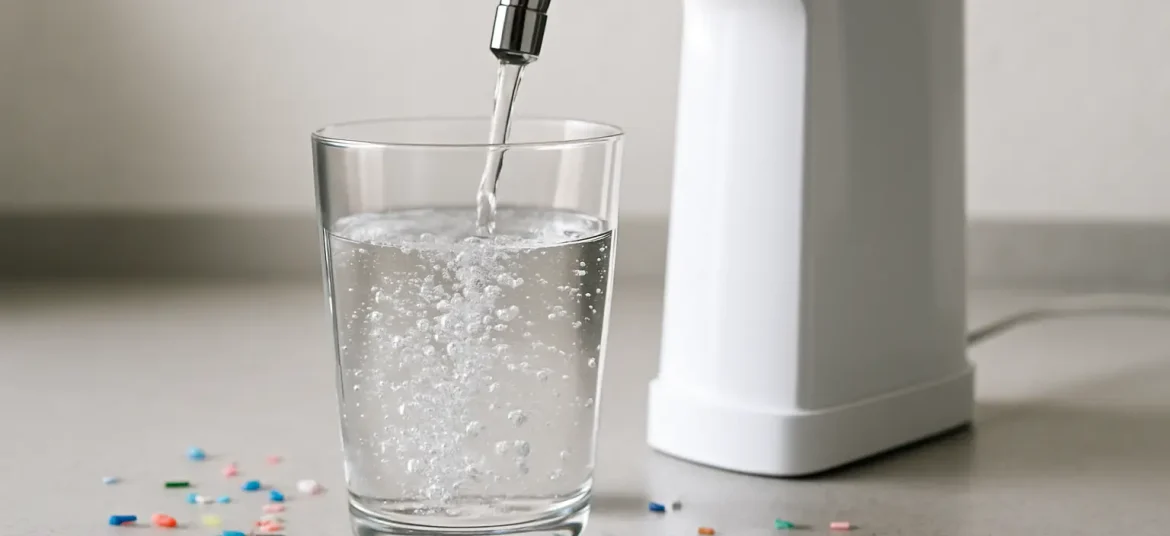
You top up a glass from the kitchen tap, or pour from a jug filter, and a question nags at the back of your mind: if microplastics are turning up everywhere, are they in my drinking water too – and if so, can my purifier actually remove them?
The honest answer is: sometimes yes, sometimes only partly. It depends on what your purifier is designed to do, how fine the filtration is, and whether the system is maintained properly. Microplastics are not a single “thing” in water – they range from visible fragments down to tiny particles that behave more like dust.
Does water purifier remove microplastics – or just improve taste?
When people ask “does water purifier remove microplastics”, they are often picturing a standard household filter that improves taste and odour. Those systems can be helpful, but taste-focused filtration does not automatically equal microplastic reduction.
Microplastics are generally defined as plastic particles smaller than 5 mm. In everyday household terms, that spans everything from small flakes you might see (rare in drinking water) down to particles measured in microns (one micron is one thousandth of a millimetre). Some of the smallest particles are harder to capture because they can pass through larger pores or behave differently under pressure.
A purifier can remove microplastics if it has a physical barrier fine enough to trap them, or if it uses a technology that reliably separates particles from water. Many “basic” filters are mainly designed for chlorine taste, some sediment, and certain organic compounds – useful benefits, but not always built to target very fine particulate matter.
What matters most: particle size and filter pore size
If you remember one practical idea, make it this: filtration is often about matching the filter’s pore size to the size of what you want to remove.
Many microplastics sit in the range where they can be reduced by finer filtration such as ultrafiltration (UF) membranes, reverse osmosis (RO), and some multi-stage systems that include tight membranes or high-performance fibre filters. Meanwhile, a simple carbon block may catch some particles, especially if it also acts as a physical barrier, but performance varies widely by design.
Because microplastics come in different sizes, a purifier may reduce them rather than remove them completely. That is not a failure – it is simply how filtration works in real kitchens.
Which purifier types are more likely to reduce microplastics?
Sediment filters (basic pre-filters)
Sediment filters are designed to catch larger particles such as sand, rust, and visible debris. They can reduce larger microplastic fragments if the fragments are bigger than the filter’s rating, but they are not a complete solution for finer microplastics.
If your system uses a sediment pre-filter, think of it as the “first gate” that protects later stages and improves overall performance.
Activated carbon filters (taste and odour)
Activated carbon is excellent for improving taste and reducing chlorine and some organic compounds. Whether it reduces microplastics depends on the physical structure of the filter. Some carbon blocks can act as a fine barrier, while loose granular carbon is less consistent for particle capture.
If a jug filter is mostly activated carbon, it may help with water aesthetics and some contaminants, but you should not assume strong microplastic reduction unless the product explicitly states particle filtration performance.
Ultrafiltration (UF) membranes
UF membranes are designed to filter very small particles, often in the sub-micron to micron range depending on the system. That makes UF a more relevant technology when the goal includes reducing microplastics, because many microplastics are within a size that UF can physically trap.
UF systems are also commonly valued for being practical in day-to-day home routines because they can provide good flow without the same water wastage profile associated with some RO installations.
Reverse osmosis (RO)
RO is one of the most effective household technologies for removing very small dissolved and particulate contaminants. Because RO membranes are extremely fine, they can be effective at reducing microplastics, including smaller particles.
The trade-off is that RO systems typically produce wastewater as part of the purification process, and they require consistent maintenance. In a busy household, that practicality question matters as much as the headline performance.
Distillation
Distillation can remove many contaminants by turning water into steam and condensing it back to liquid, leaving many solids behind. It can reduce microplastics, but it is usually slower and less convenient for daily family hydration unless it is built into your routine.
A more realistic question: “How much reduction can I expect?”
For most households, the most helpful way to think about microplastics is reduction, not perfection.
Even if a purifier performs well, your overall exposure depends on more than just the filter. How you store water, the condition of your bottles, and your daily habits can make a difference. For example, repeatedly reusing old, scratched plastic bottles or leaving bottled water in a hot car can increase the chance of plastic shedding into the water.
So yes, filtration matters – but it works best when paired with sensible handling.
What to look for when choosing a purifier for microplastics
Product descriptions can be confusing because many brands focus on taste, convenience, or general “purification” language. To make a confident choice, look for clear, technical signals.
Start with the filtration type: a system that includes UF or RO is generally more relevant for microplastic reduction than one that is only a basic carbon stage.
Next, look for a micron rating or membrane specification. When a product tells you the filtration size it can physically block, you have a stronger basis for understanding what it may reduce.
Finally, check that the system is designed for consistent daily use. A high-performing system that is annoying to maintain often ends up used inconsistently, which reduces its real-world benefit.
Maintenance is not optional if you want consistent filtration
Microplastics are particles, and particles load up filters.
If cartridges are not replaced on schedule, two things can happen. First, flow rate drops and people start bypassing the system or stop using it. Second, performance becomes unpredictable because a clogged or degraded filter no longer behaves like it did when new.
A simple household habit helps: set a calendar reminder based on the manufacturer’s replacement guidance, and keep spare cartridges ready. If your purifier has indicators, take them seriously, but do not rely on indicators alone if your household uses more water than average.
Everyday habits that support lower microplastic exposure
A purifier is only part of the story. Without turning it into a big lifestyle project, a few realistic choices can help.
Using glass or stainless-steel bottles for daily drinking can reduce the chance of extra plastic particles entering your water after filtration. If you prefer plastic for children’s school bottles, choose good-quality options and replace them when they become cloudy or scratched.
Heat also matters. Try not to store drinking water in plastic containers in very warm places, such as in a car boot during a hot afternoon. It is a small change, but it fits naturally into daily life.
Where hydrogen water fits in – and where it doesn’t
Some households exploring water quality also look at hydrogen water for daily hydration enjoyment and routine support. It is worth separating two ideas that are often mixed together.
Hydrogen generation is not the same thing as filtration. A hydrogen water device may focus on dissolving hydrogen into water for a different experience and routine, while filtration is about removing unwanted substances.
If microplastic reduction is your priority, you still need to pay attention to the purifier’s filtration technology, not just whether the water is hydrogen-enriched. Some home systems combine these concepts in one ecosystem, which can be convenient if you want both hydration routines and water quality support. If you are comparing options, keep the questions separate: “What does it filter?” and “What does it add or change?”
For readers who prefer a guided way to explore household hydration and water purification features under one roof, you can browse education and product options at Elken and focus on the filtration specs and maintenance expectations that match your family’s routine.
FAQs people ask when they’re deciding
Are microplastics definitely in tap water?
Microplastics have been detected in many environments, including water sources, but levels can vary by location, sampling method, and even household plumbing conditions. Rather than assuming the worst, it is more useful to focus on controllable steps: choose a purifier with suitable filtration and maintain it well.
Will boiling water remove microplastics?
Boiling can kill microbes, but it does not reliably remove microplastics because plastics do not simply disappear with heat at boiling temperatures. If microplastic reduction is the goal, you need a filtration or separation method that physically removes particles.
Does bottled water solve the problem?
Bottled water can still contain microplastics, and the packaging itself can be a source. If you enjoy the convenience of bottled water, consider using it selectively, and keep daily home hydration centred on a well-maintained purifier and sensible storage.
If I have a carbon filter jug, should I upgrade?
A jug can be a good start for taste and convenience, especially in a small household. If your main concern is particle reduction, including microplastics, it may be worth considering a system with UF or RO, provided it fits your space, budget, and maintenance habits.
Choosing a water purifier is less about chasing the “perfect” system and more about picking something you will actually use every day. If your purifier matches your household routine and you keep up with cartridge changes, microplastic reduction becomes a practical, achievable part of better daily hydration – quiet, consistent, and easy to live with.